Table of Contents
Tri Tip (2 Ways) – The Ultimate Guide to Grilling or Oven-Roasting
If you have never had tri tip, you haven’t lived. I mean that from the bottom of my heart. Growing up in Morocco, my mother would slow-roast tough cuts of beef with warm spices until they turned into something magical. But tri tip? I didn’t discover that beauty until I moved to California as a young cook. This cut, also called a bottom sirloin butt or triangle roast, is everything you want in beef: deep flavor, tender texture, and a price tag that won’t make you wince. And now, living in New York City, I make tri tip two ways — on the grill when the weather cooperates, or in the oven when the city is buried in snow. I’ll show you both methods, plus my secret to a foolproof pan sauce that’ll have everyone licking their plates.
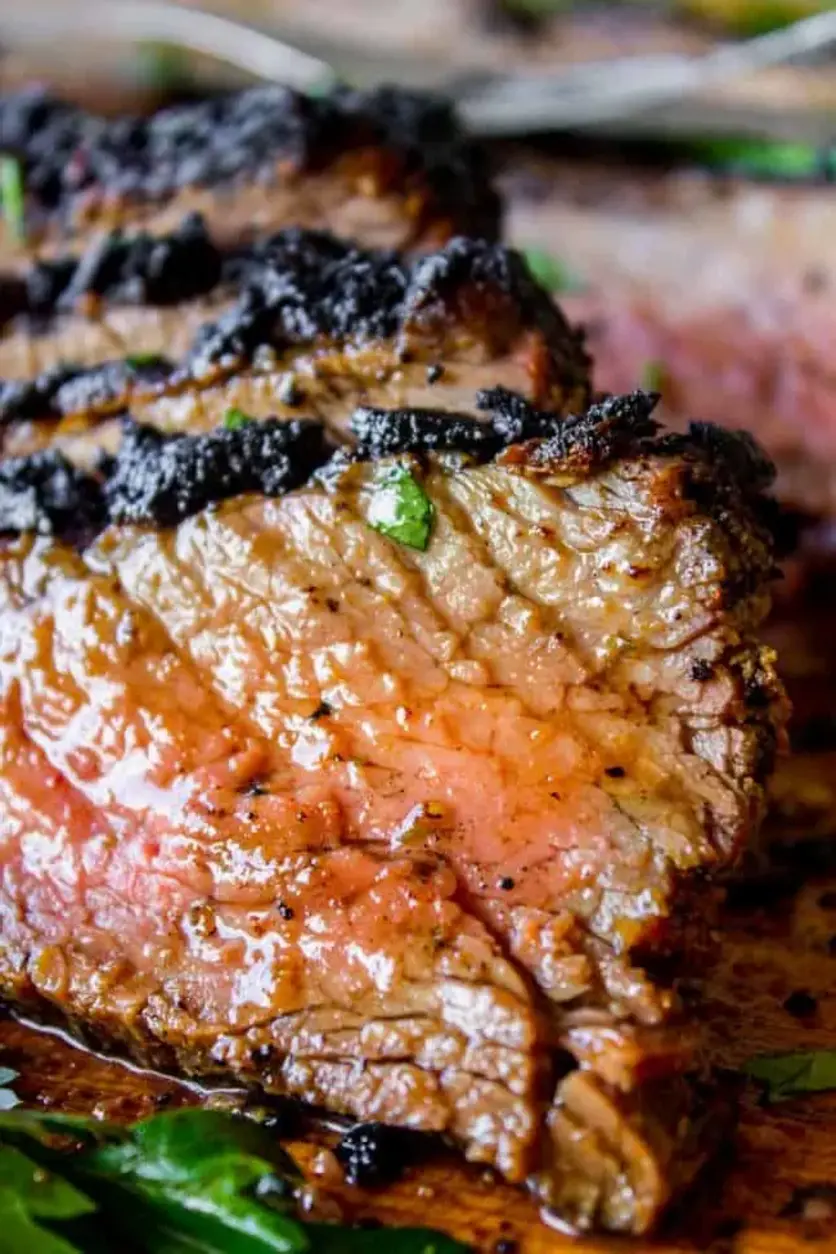
This roast has a gorgeous crust after searing, thanks to a simple rub of garlic salt, Lawry’s, kosher salt, pepper, sugar, garlic powder, and parsley. The sugar caramelizes against the heat, creating a mahogany bark that gives way to juicy, pink meat inside. Whether you cook it over charcoal or in a 400°F oven, the aroma fills your kitchen with that unmistakable scent of a special occasion. My grandmother would have called it lham mcharmel — meat cooked with love and patience. And honestly, that’s exactly what this is.
What sets my version apart is that I give you both paths — grilling and oven-roasting — with the exact same rub and technique, so you can choose based on your mood and your kitchen. Plus, I’ll walk you through exactly how to slice against the grain (with photos in the full post) and how to turn those drippings into a silky, buttery pan sauce that makes the whole dish taste like a steakhouse dinner. I’ve tested this recipe dozens of times in my tiny NYC kitchen and on my friend’s backyard grill in Brooklyn. Trust me — this one’s a keeper.
Why This Tri Tip (2 Ways) Recipe Is the Best
The Flavor Secret — The rub is a masterful balance of three salts (garlic salt, Lawry’s, and kosher salt) with just a whisper of sugar to help with caramelization. This isn’t just a spice blend; it’s a technique I learned at culinary school in Paris, where we were taught that salt draws out moisture, and sugar helps create a crust. By letting the meat marinate for at least an hour (or up to three days!), the seasoning penetrates deep into the fibers, so every bite is flavorful, not just the outside.
Perfected Texture — Tri tip is naturally tender when cooked to medium-rare, but it can turn tough if you overcook it. I use a two-zone cooking method — sear over high heat, then finish over indirect low heat — which is exactly how the best steakhouses in NYC handle their prime cuts. The result is a roast that’s evenly cooked from edge to center, with a red-pink heart and a crisp exterior. No gray bands, no dry edges.
Foolproof & Fast — Even if you’ve never cooked a tri tip before, you can nail this recipe. I give you exact temperatures (135°F for rare, 145°F for medium-rare), visual cues, and a detailed step-by-step. Whether you’re using a gas grill, charcoal, or a standard oven, the principles are the same. And because tri tip is smaller than a brisket or prime rib, it cooks in under 30 minutes. Perfect for a weeknight dinner that feels like a holiday feast.
Tri Tip (2 Ways) Ingredients
I buy my tri tip from a local butcher in the West Village — they know me by name and always set aside a well-marbled “prime” cut for me. If you don’t have a butcher nearby, go to a high-end grocery store and ask for a “California cut” or “triangle roast.” The quality of the meat makes a huge difference here, so don’t skimp. In my mother’s kitchen in Morocco, we’d use a similar cut called l’ham from the sirloin, and she’d always say, “The meat tells you what it needs.” Listen to your meat — look for marbling, a fresh red color, and even shape.
Ingredients List
- 2 ½ pound tri tip roast (also called bottom sirloin butt or triangle roast)
- 1 ½ teaspoons garlic salt
- 1 tablespoon Lawry’s seasoning salt
- 1 ½ teaspoons kosher salt (Diamond Crystal preferred)
- 1 teaspoon black pepper
- ½ teaspoon sugar
- 2 teaspoons garlic powder
- 1 tablespoon dried parsley (or 2–3 tablespoons fresh)
- ¼ cup olive oil
- For the pan sauce (optional): 2 cups beef broth, 3 tablespoons flour, ⅓ cup cold water, 2 tablespoons butter, salt and pepper to taste
Ingredient Spotlight
Tri Tip Roast: This triangular cut comes from the bottom sirloin. Look for one that’s at least 2 pounds and has good marbling — thin white lines of fat running through the meat. If you can, ask for a “prime” grade, which has more fat and will take a little longer to cook but rewards you with incredible flavor. A standard choice or select grade will cook faster but may shrink more.
Lawry’s Seasoning Salt: This is my secret weapon for a reason. It’s a blend of salt, sugar, paprika, turmeric, onion powder, and garlic powder. It adds complexity that you can’t get from just kosher salt alone. In a pinch, you can substitute with a mix of 1 teaspoon salt, ½ teaspoon paprika, and ¼ teaspoon onion powder.
Kosher Salt (Diamond Crystal): Not all salts are created equal. Diamond Crystal has a light, flaky texture that dissolves evenly and sticks to the meat without making it too salty. Table salt is much denser and will over-salt your roast. If you only have Morton’s kosher, use about half the amount I call for, or adjust to taste.
Substitutions Table
| Original Ingredient | Best Substitution | Flavor / Texture Impact |
|---|---|---|
| Lawry’s Seasoning Salt | 1 tsp salt + ½ tsp paprika + ¼ tsp onion powder | Slightly less complex but still very good |
| Diamond Crystal Kosher Salt | Morton’s kosher salt (use ½ amount) | Denser salt, easier to over-salt; adjust carefully |
| Dried Parsley | 2–3 tbsp fresh parsley, chopped fine | Brighter, fresher flavor; more vibrant color |
| Olive Oil (for marinade) | Avocado oil or grapeseed oil | Neutral flavor, works perfectly; no significant difference |
| Beef Broth (for pan sauce) | Chicken broth + 1 tsp beef bouillon | Lighter color, still savory; add bouillon for depth |
How to Make Tri Tip (2 Ways) — Step-by-Step
Don’t worry — this recipe is simpler than it looks. Whether you choose the grill or the oven, you’ll follow the same first five steps. I’ll guide you through each one with the exact timing and visual cues you need to nail it every time.
Step 1: Choose Your Meat
If you can, get your tri tip from a local butcher. They will have what are called “prime” cuts, which have more fat and marbling than what you’ll find at the grocery store. Prime cuts take a little longer to cook because of the extra fat — but fat equals flavor, and the result is a noticeably juicier roast. If you buy from a high-end grocery store, look for a roast that’s deep red with thin white streaks of fat. Avoid discount stores for this cut; the meat will be leaner, shrink more during cooking, and won’t have the same tenderness.
💡 emy’s Pro Tip: Ask your butcher for a “California cut” or “triangle roast.” If they still look confused, just say “bottom sirloin butt (subprimal cut).” That usually does the trick.
Step 2: Make the Dry Rub
In a small bowl, combine the garlic salt, Lawry’s seasoning salt, kosher salt (Diamond Crystal only!), black pepper, sugar, garlic powder, and parsley. If you’re using fresh parsley, chop it fine and use 2–3 tablespoons. The dried version works beautifully, too — just rub it in well so it sticks to the meat.
⚠️ Common Mistake to Avoid: Don’t use table salt. It’s much denser than kosher salt and will over-salt your roast. Trust me — I learned this one the hard way at culinary school in Paris!
Step 3: Marinate
Rub the spice mixture all over the roast with your hands. Place it in a large ziplock bag, add ¼ cup olive oil, seal the bag, and massage the oil into the meat. Pop it in the fridge and marinate for at least 1 hour — but ideally 8 hours, turning the bag a couple of times. You can leave it for up to 3 days for maximum flavor. Even 15 minutes will give you a good roast, so don’t stress if you’re short on time.
💡 emy’s Pro Tip: If you marinate for less than 4 hours, consider poking a few small holes in the meat with a fork before rubbing. This helps the seasoning penetrate a little faster.
Step 4: Bring to Room Temp
Remove the meat from the fridge 30 minutes before you plan to cook it. This is crucial for even cooking — a cold roast will cook unevenly, with the outside overcooking before the center is done. Let it sit on the counter, still in the bag, while you preheat your grill or oven.
⚠️ Common Mistake to Avoid: Don’t leave it out for more than 45 minutes. You want it at room temperature, not warm. And never leave raw meat out for more than 2 hours total.
Step 5: Sear
For the grill: Preheat your grill to high heat (15–20 minutes). Remove the roast from the bag, discard the marinade (or save it for the pan sauce), and pat the meat dry. Grease the grill grates or brush oil directly onto the meat. Sear over high heat for 2–3 minutes per side, keeping the lid shut as much as possible. You’re looking for a deep, mahogany-brown crust.
For the oven: Preheat your oven to 400°F. Heat a large skillet over medium-high heat with 2 tablespoons olive oil. When the oil shimmers, place the roast in the pan, fat side down. Sear for 3–4 minutes until a brown crust forms. Flip and sear the other side. Then transfer the roast to a foil-lined baking sheet with an oven-safe cooling rack on top.
💡 emy’s Pro Tip: If you’re grilling, trim the fat cap before searing. For oven-roasting, leave the fat cap on — it bastes the meat as it cooks and adds incredible flavor to the pan drippings.
Step 6: Cook Indirectly
For the grill: After searing, turn off the heat on the side of the grill where the meat is. You’re cooking over indirect heat now. Lower the other side to low heat. Close the lid and cook for 20–25 minutes (about 10–15 minutes per pound), without opening the lid. Use a meat thermometer to check: 135°F for rare, 145°F for medium-rare.
For the oven: Place the seared roast (on the cooling rack over the baking sheet) in the 400°F oven. Bake for 20–30 minutes (10–15 minutes per pound). Check the temperature — rare is 130–135°F, medium-rare is 135–145°F. Do not cook past 145°F; the meat doesn’t have enough fat for medium-well or well.
⚠️ Common Mistake to Avoid: Don’t rely on cooking time alone. Every roast is different — a well-marbled prime cut will take longer than a lean choice cut. Always use a meat thermometer inserted in the center of the thickest part.
Step 7: Rest
Remove the roast from the grill or oven and place it on a rimmed serving platter. Cover it well with foil and let it rest for 10–15 minutes. This is not optional — resting allows the juices to redistribute throughout the meat, so every slice is moist and tender. If you skip this step, all those beautiful juices will run out onto the cutting board.
💡 emy’s Pro Tip: While the meat rests, make the pan sauce (see Step 9). Use the drippings from the platter — they’re pure gold.
Step 8: Slice Against the Grain
Tri tip has a unique shape — it’s a triangle, and the grain changes direction in the middle. Look at the meat carefully: you’ll see lines of muscle fibers running in one direction on the wider end and in a different direction on the narrower end. Slice perpendicular to those lines (against the grain) for the most tender pieces. If you slice with the grain, you’ll end up with chewy, stringy meat.
⚠️ Common Mistake to Avoid: Not identifying the grain before you slice. Take a moment to look at the roast. If you see the lines running one way, cut across them. If you’re not sure, make a small cut on the end — you’ll see the grain clearly once you start.
Step 9: Optional Pan Sauce (The Best Part)
While the meat rests, save all the drippings from the platter and any leftover marinade. In a small saucepan, bring 2 cups beef broth to a boil. In a small bowl, whisk ⅓ cup cold water with 3 tablespoons flour until smooth. Slowly pour the flour mixture into the boiling broth, whisking constantly. Simmer for 5–10 minutes until thickened to your liking. Remove from heat, stir in 2 tablespoons butter, and season with salt and pepper. Pour over the sliced tri tip — it’s heaven.
💡 emy’s Pro Tip: For an even richer sauce, add a splash of heavy cream or a teaspoon of Dijon mustard at the end. This is how we make sauce in Paris — simple, elegant, and deeply flavorful.
| Step | Action | Duration | Key Visual Cue |
|---|---|---|---|
| 1 | Sear (grill or stovetop) | 2–4 mins per side | Deep mahogany-brown crust |
| 2 | Cook indirectly (grill) or oven-roast | 20–30 mins (10–15 mins/lb) | Internal temp: 135°F rare / 145°F med-rare |
| 3 | Rest | 10–15 mins | Juices recede, meat firms slightly |
| 4 | Slice against the grain | Immediate | Clean, even slices; meat doesn’t shred |
| 5 | Make pan sauce (optional) | 5–10 mins | Sauce coats the back of a spoon |
Serving & Presentation
Slice the rested tri tip against the grain and arrange the pieces on a large wooden board or a white platter — the contrast of the pink meat against the dark crust is absolutely stunning. Drizzle a little of the pan sauce over the top and serve the rest on the side in a small gravy boat. I like to scatter a few fresh parsley leaves over the meat for color, and maybe a sprinkle of flaky sea salt (like Maldon) right before serving.
In my family, tri tip is always served with Santa Maria Pinquito Beans — it’s the traditional California pairing and it’s absolutely perfect. But in my NYC kitchen, I also love serving it with roasted potatoes (tossed in olive oil and rosemary), a crisp arugula salad with lemon vinaigrette, or creamy polenta. The pan sauce ties everything together beautifully.
For a Moroccan twist, serve the tri tip with a side of warm couscous tossed with raisins, toasted almonds, and a pinch of cinnamon. The sweetness of the raisins and the nuttiness of the almonds complement the savory, smoky meat in a way that feels both familiar and exciting. My mother would approve.
| Pairing Type | Suggestions | Why It Works |
|---|---|---|
| Side Dish | Santa Maria beans, roasted potatoes, couscous, arugula salad | Earthy, creamy, or acidic sides balance the rich beef |
| Sauce / Dip | Pan sauce, chimichurri, horseradish cream | Adds moisture, brightness, or heat to each bite |
| Beverage | Zinfandel, Malbec, dark lager, iced tea with mint | Bold reds match the beef; crisp beer cuts the richness |
| Garnish | Fresh parsley, flaky sea salt, lemon wedges | Freshness and crunch elevate the presentation |
Make-Ahead, Storage & Reheating
Tri tip is one of the best meats to meal-prep for a busy week. I often cook two roasts at once — one for dinner that night and one to slice and use in lunches. The key is to store the meat properly so it stays juicy and doesn’t dry out. Here’s my system, tested through countless NYC winters and summer barbecues.
| Method | Container | Duration | Reheating Tip |
|---|---|---|---|
| Refrigerator | Airtight container or wrapped tightly in foil | 3–4 days | Reheat slices in a skillet with a splash of beef broth over medium heat, 2–3 mins per side |
| Freezer | Vacuum-sealed or freezer-safe bag, sliced or whole | 2–3 months | Thaw overnight in fridge, then reheat in a 300°F oven with foil tent, 10–15 mins |
| Make-Ahead | Cook and slice, store separate from sauce | 2 days in advance | Reheat sauce separately to avoid sogginess |
My favorite way to reheat leftover tri tip is to slice it thin and quickly sear it in a hot cast-iron skillet with a little butter. The butter adds richness and helps restore the crust. If you’re reheating the whole roast, wrap it in foil with a tablespoon of beef broth and warm it in a 300°F oven for 12–15 minutes. Don’t use the microwave — it will toughen the meat and make it dry.
For lunches, I use leftover tri tip in sandwiches (on a crusty roll with horseradish cream and arugula), in tacos (with salsa verde and pickled onions), or sliced cold over a salad with blue cheese and walnuts. It’s honestly just as delicious cold as it is hot — maybe even better the next day, when the flavors have fully melded.
Variations & Easy Swaps
| Variation | Key Change | Best For | Difficulty Impact |
|---|---|---|---|
| Moroccan Spice Rub | Add 1 tsp cumin, 1 tsp paprika, ½ tsp cinnamon, ½ tsp ginger | Aromatic, warm, exotic flavor | Easy |
| Garlic Herb Butter Baste | After searing, baste with 3 tbsp butter + 2 cloves garlic + rosemary | Extra richness, steakhouse flavor | Easy (adds 2 mins) |
| Spicy Chipotle Tri Tip | Add 1 tsp chipotle powder + ½ tsp cayenne to rub | Smoky heat, Southwestern vibe | Easy |
Moroccan Spice Rub Variation
This is my personal favorite — it takes me straight back to my mother’s kitchen in Morocco. Add 1 teaspoon ground cumin, 1 teaspoon sweet paprika, ½ teaspoon cinnamon, and ½ teaspoon ground ginger to the dry rub. The cinnamon and ginger add a warmth that pairs beautifully with the smoky grill flavor. Serve this version with couscous and a side of roasted carrots drizzled with honey and harissa. The combination is absolutely magical.
Garlic Herb Butter Baste
After you sear the tri tip and move it to indirect heat (or into the oven), melt 3 tablespoons of butter in a small saucepan with 2 crushed garlic cloves and a sprig of fresh rosemary. Baste the roast with this butter every 5 minutes during cooking. The butter adds richness and helps form an even more luxurious crust. This is the technique I learned at culinary school in Paris — it’s how they finish a steak at Le Cordon Bleu. It takes just a few extra minutes but makes the meat taste like it came from a high-end steakhouse.
Spicy Chipotle Tri Tip
For a smoky, Southwestern spin, add 1 teaspoon chipotle powder and ½ teaspoon cayenne pepper to the dry rub. The chipotle gives the meat a subtle smokiness that pairs perfectly with a tangy lime crema (sour cream + lime juice + salt). I discovered this combination at a taco stand in Brooklyn’s Smorgasburg market, and it was love at first bite. Serve this variation with warm corn tortillas, pickled red onions, and a sprinkle of cotija cheese.
What is tri tip and where does it come from?
Tri tip is a triangular cut of beef from the bottom sirloin, also called a “California cut” or “triangle roast.” It originated in California — specifically, it was popularized by Santa Maria-style barbecues in the central coast region. The cut is known for its excellent marbling, rich beefy flavor, and tender texture when cooked to medium-rare. It’s smaller than a brisket or prime rib, making it perfect for a weeknight dinner that feels special. You can find it at butcher shops and high-end grocery stores; ask for a well-marbled one for the best results.
How long should I marinate tri tip?
Ideally, marinate your tri tip for 8 hours in the refrigerator. This gives the salt and spices enough time to penetrate the meat and season it all the way through. However, even 15 minutes will give you a flavorful roast — it’s just that the longer you marinate (up to 3 days), the deeper the flavor will be. If you’re short on time, poke a few small holes in the meat with a fork before adding the rub to help the seasoning absorb faster. Always marinate in a sealed ziplock bag and turn it a couple of times during the process.
What temperature should tri tip be cooked to?
For tri tip, the ideal internal temperature is 135°F for rare, and 145°F for medium-rare. Use a meat thermometer inserted into the thickest part of the roast to check. Do not cook it past 145°F — tri tip doesn’t have enough fat to stay tender at medium-well or well-done. If you prefer your meat more done, I recommend choosing a different cut (like chuck roast or brisket) that benefits from longer cooking. After you pull the roast from the heat, remember to let it rest for 10–15 minutes so the juices redistribute.
How do I slice tri tip against the grain?
Tri tip has a unique shape — it’s a triangle — and the grain (the lines of muscle fibers) changes direction in the middle. To slice against the grain, first look at the roast and identify the direction of the fibers. On the wider end, the grain usually runs one way; on the narrower end, it runs a different way. Slice perpendicular to those lines. If you slice with the grain, the meat will be chewy and tough. A good trick: make a small test cut at one end — if the fibers are running parallel to your knife, you’re going the wrong way. Adjust and slice across the fibers for the most tender pieces.
Can I cook tri tip in the oven instead of on the grill?
Absolutely! This recipe gives you both methods. For the oven, preheat to 400°F, sear the roast in a hot skillet with olive oil (3–4 minutes per side), then transfer it to a foil-lined baking sheet with an oven-safe cooling rack on top. Bake for 20–30 minutes (10–15 minutes per pound) until it reaches 135°F for rare or 145°F for medium-rare. The oven method produces a beautifully even cook and leaves you with delicious pan drippings for a sauce. It’s perfect for colder months or when you don’t have access to a grill.
What is the best way to reheat leftover tri tip?
My favorite way to reheat leftover tri tip is to slice it thin and quickly sear it in a hot cast-iron skillet with a little butter. This takes about 2–3 minutes per side and restores that gorgeous crust. For larger pieces, wrap the roast in foil with a tablespoon of beef broth and warm it in a 300°F oven for 12–15 minutes. Avoid the microwave — it will toughen the meat and make it dry. Leftover tri tip is also delicious cold in sandwiches, tacos, or salads, so don’t feel like you have to reheat it at all.
What are the best side dishes to serve with tri tip?
The traditional California pairing is Santa Maria Pinquito Beans — small pink beans cooked with bacon, garlic, and spices. But there are so many great options! I love roasted potatoes (tossed with olive oil and rosemary), a crisp arugula salad with lemon vinaigrette, creamy polenta, or grilled vegetables like asparagus and bell peppers. For a Moroccan twist (my personal favorite), serve the tri tip with warm couscous tossed with raisins, toasted almonds, and a pinch of cinnamon. The pan sauce from the drippings ties everything together beautifully.
Can I freeze cooked tri tip?
Yes, cooked tri tip freezes very well. Slice it or leave it whole, then wrap it tightly in foil or place it in a freezer-safe bag. It will keep for 2–3 months. When you’re ready to use it, thaw overnight in the refrigerator. To reheat, wrap in foil with a splash of beef broth and warm in a 300°F oven for 10–15 minutes. I recommend storing the pan sauce separately to avoid sogginess. Frozen and reheated tri tip is perfect for quick weeknight meals — just slice and add to tacos, salads, or sandwiches.
Is tri tip the same as brisket?
No, tri tip and brisket are different cuts. Tri tip comes from the bottom sirloin (the back of the cow), while brisket comes from the chest area. Tri tip is smaller (usually 2–3 pounds), cooks much faster (20–30 minutes), and is best served medium-rare. Brisket is larger (10–15 pounds), requires low-and-slow cooking (8–12 hours), and is typically cooked to well-done for barbecue. Tri tip has more marbling than brisket and a more intense beef flavor. Both are delicious, but they require completely different cooking methods.
Why does my tri tip turn out tough?
Tri tip turns out tough for one of two reasons: overcooking or slicing incorrectly. If you cook it past 145°F, the meat becomes dry and chewy because it doesn’t have enough fat to stay tender at higher temperatures. Always use a meat thermometer and pull the roast at 135–145°F. The second reason is slicing with the grain instead of against it. Tri tip has a distinctive grain pattern that changes direction — take a moment to identify the fibers and slice perpendicular to them. If you follow these two rules, your tri tip will be tender every time.
Share Your Version!
I absolutely love hearing how my recipes turn out in your kitchen! If you made this Tri Tip (2 Ways) recipe, please leave a star rating and a comment below — tell me which method you tried (grill or oven) and how you served it. Did you make the pan sauce? Did you try the Moroccan spice variation? I read every single comment and I love learning about your twists and discoveries.
And if you’re on social media, snap a photo of your beautiful tri tip and share it with me! Tag @cookingwithemi on Instagram or Pinterest — I’d love to feature your creation in my stories. And here’s a question for you: what’s your favorite side dish to serve with tri tip? I’m always looking for new ideas to try in my NYC kitchen! 🧡
From my NYC kitchen to yours — I hope this recipe brings as much warmth to your table as it does to mine. — emy 🧡
Love This Recipe? Save It to Pinterest!
If you enjoyed this Tri Tip (2 Ways) recipe, don’t let it get lost in your browser tabs! 😄 Pin it now so you can find it again anytime — and explore hundreds more tried-and-tested recipes waiting for you on my Pinterest boards.
👉 Follow emy on Pinterest @exorecipe
📌 Pin this recipe · 🔁 Re-pin your favorites · 💬 Tag me when you make it — I love seeing your creations!
⭐️ Did you make this recipe? I’d love to hear from you!
Leave a star rating below, share a photo on Instagram tagging @cookingwithemi, or save this recipe to your Pinterest board! Your support means the world to me. 🧡
Tri Tip (2 Ways)
Description
If you have never had tri tip, you haven’t lived! I will show you how to cook tri tip on the grill or in the oven, it’s SO easy and the flavor is unbeatable! We always had tri tip for Christmas dinner growing up, it’s an impressive main dish!
Ingredients
- 2 & 1/2 pound tri tip roast
- 1 & 1/2 teaspoons garlic salt
- 1 tablespoon Lawry's seasoning salt
- 1 & 1/2 teaspoons kosher salt (Diamond Crystal)
- 1 teaspoon black pepper
- 1/2 teaspoon sugar
- 2 teaspoons garlic powder
- 1 tablespoon dried or fresh parsley
- 1/4 cup olive oil
Instructions
- If you can, get your tri tip from a local butcher. They will have what is called "prime" cuts, which has more fat and marbling than you can find at the grocery store. It will take longer to cook because of all the fat. (Fat=flavor)
- If you buy your tri tip at the grocery store, make sure that you go to a high-end grocery store. High-end grocery stores are going to have mid-range cuts of meat. A discount store is going to have discount meat, and it will not be marbled well. Your roast will shrink a lot more and it will take a shorter time to cook.
- Ask the butcher or grocery clerk for a well marbled tri tip roast, or "California cut" or a "triangle roast." If they still don't know what you mean, ask for the bottom sirloin butt (subprimal cut).
- In a small bowl, combine all the spices: galic salt, seasoning salt, kosher salt (only kosher salt, never table salt, and preferably Diamond Crystal!), pepper, sugar, garlic powder, and parsley. 1 tablespoons of dried parsley is fine, you can use 2-3 tablespoons if you are using fresh parsley.
- If you are grilling, trim the fat cap from the roast. If you are oven roasting, leave it on.
- Rub the spice mixture all over the roast with your hands. Place in a large ziplock bag and add 1/4 cup olive oil. Seal the bag and massage the oil into the meat. Place in the fridge and marinate, turning a couple times, for about 8 hours. (This is ideal. If you only have an hour or even 15 minutes, guess what, you're still going to get a great roast. But the longer you marinate, the more flavor there will be. You can leave it in the fridge for up to 3 days.)
- Remove the meat from the fridge 30 minutes before you plan to cook it. It should start cooking at room temperature.
- Preheat your grill to high heat. Make sure you give it a good 15-20 minutes to heat up.
- Place the roast on a plate and discard the marinade (or save it to add to a pan sauce if you plan to make one).
- Grease the grill (or brush oil directly on the meat).
- Sear the roast over high heat for about 2-3 minutes, until it is nicely browned. Flip over (grease again if necessary) and sear the other side for 2-3 minutes. Keep the lid shut as much as you can.
- Turn off the heat on the side of the grill that your meat is on. We are cooking it over INDIRECT heat. Lower the other side of the grill to low heat. If you are cooking over charcoals, arrange the meat and charcoals so that the meat is off to the side, not cooking directly above the charcoal.
- Grill without opening the lid for about 20-25 minutes, or about 10-15 minutes per pound, depending on how rare you want it. Rare is 135 degrees F. Medium rare is 145 degrees F. Use a meat thermometer inserted in the center of the roast to check the temperature.
- Remove the roast from the grill, and place on a rimmed serving platter. Cover well with foil and let rest for 10-15 minutes.
- Slice against the grain and serve (see photos). Try this tri tip with it's traditional side dish, Santa Maria Pinquito Beans!
- Remove the meat from the fridge 30 minutes before you plan to cook it. It should start cooking at room temperature.
- Preheat your oven to 400 degrees F.
- Line a rimmed baking sheet with foil and place an oven-safe cooling rack on top, and set aside.
- Heat a large skillet over medium high heat. Add 2 tablespoons olive oil. When the oil shimmers, place the roast in the pan, fat side down. Sear the roast for about 3-4 minutes, until a brown crust has developed. Flip and sear the other side.
- Place the roast on the cooling rack. Save the marinade and oil from searing for a pan sauce, if you choose to make one.
- Put the roast in the oven and bake at 400 degrees for about 20-30 minutes, or about 10-15 minutes per pound, depending on how rare you want it. Rare is 130-135 degrees F. Medium rare is 135-145 degrees F. Don't cook it past 145; the meat doesn't have enough fat for medium well or well. Use a meat thermometer inserted in the center of the roast to check the temperature.
- Remove the roast from the oven, and cover well with foil. Let rest for 10-15 minutes.
- Slice against the grain and serve (see photos). Try this tri tip with it's traditional side dish, Santa Maria Pinquito Beans!
- Save all meat drippings* and excess marinade. Add to a small saucepan with 2 cups beef broth.* Bring to a boil. In a small bowl, combine 1/3 cup cold water and 3 tablespoons flour. Whisk until smooth, and then slowly pour into the boiling broth. Continue simmering for 5-10 minutes until thickened. Add 2 tablespoons butter, season with salt and pepper, and serve with meat.